Projects
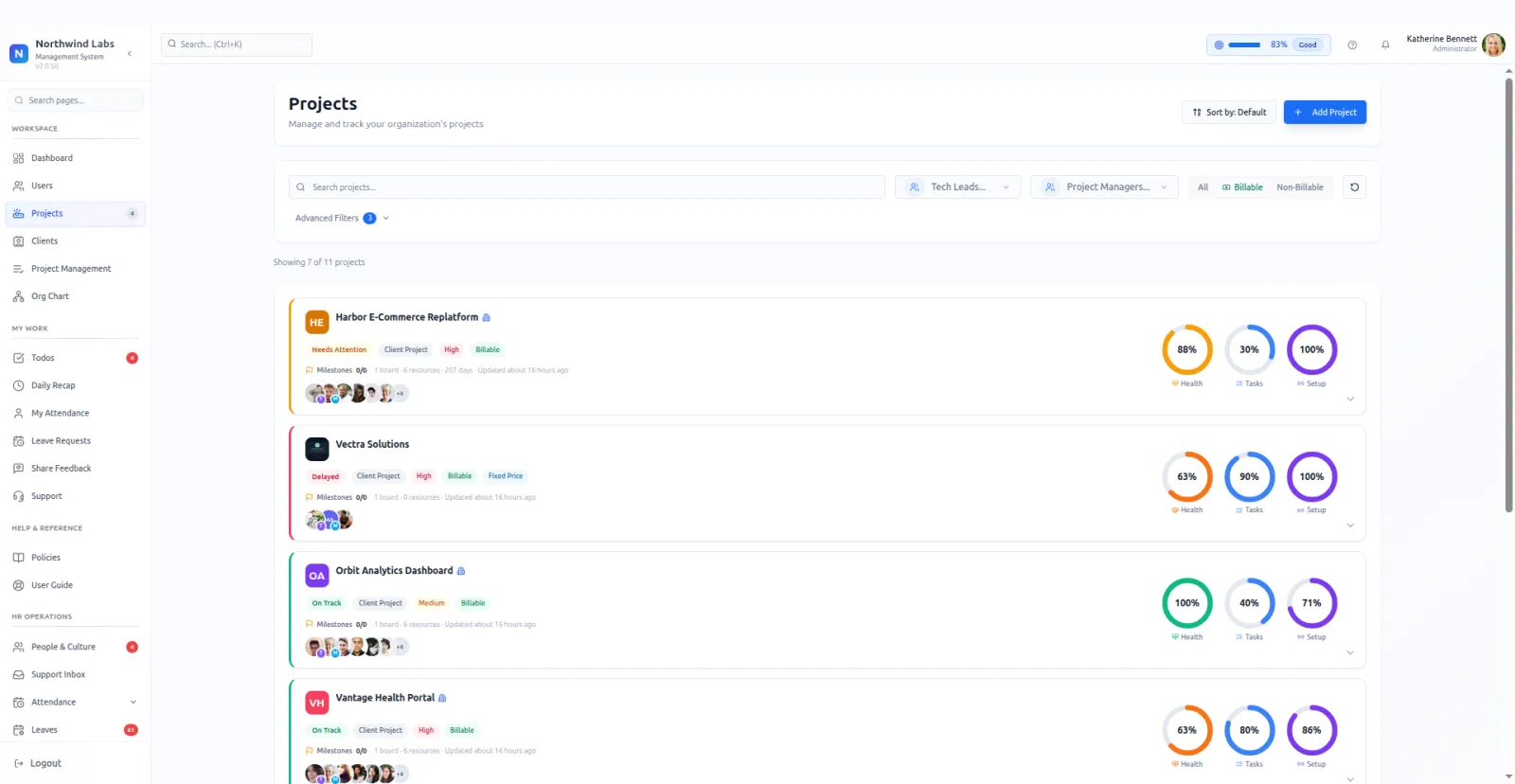
Portfolio lists usually rot because nobody updates a status field. Three scores here are computed from what the project does, and a fourth signal watches for silence.
Every project belongs to a client and names a contact. Status runs On Track or Needs Attention, and priority runs High, Medium or Low.
Three scores sit on each project: Health, Tasks and Setup, each as a percentage. Setup is the useful one nobody else shows. A project can be healthy and still half configured.
A row carries its milestone count, board count, how many people are on it, and its age in days. Last updated and last meeting sit at the end.
The quiet-project warning reads a line like No meeting in 36d. That threshold is a setting, not a hard-coded number, and it starts at 14 days.
Filters cover tech leads, project managers, and the billable flag. An advanced panel narrows further for anyone running more projects than fit on a screen.
The live portfolio holds 59 projects with 11 showing under the default filter. Which is the shape most delivery teams are in: a long tail of old work behind a short list of live work.
Read the three scores together and a pattern shows up quickly. A project with good health and a poor setup score is usually one that got started in a hurry and never came back.
What it does
- Health, Tasks and Setup
- Three percentages per project. Setup catches the project that was never finished being set up, which usually explains the other two.
- A configurable quiet warning
- Projects with no recent meeting are flagged. The gap that triggers it is a tenant setting and starts at 14 days.
- Milestones and boards per project
- A row shows milestones done against milestones planned, and how many boards the project runs.
- Filters by lead and manager
- Tech leads and project managers each get a filter, so a lead sees only the work they answer for.
What it needs before it works
- Clients come first. A project hangs off a client record, and the client's contacts become the project's contacts.
- Health scoring uses the project health settings. Five of the tenant's settings sit in that category, so what counts as healthy is a decision the company makes once.
- The meeting gap warning needs meetings flowing in. Without the Fireflies import there is no last-meeting date for it to measure from.
- Someone with the projects permission sets the billable and fixed-price flags. They are labels on the record, set by a person.
Questions people ask
What does the Setup score measure?
How fully the project has been configured. A project can be healthy and still half set up, and the Setup score is where that shows.
How is project health calculated?
From the project health settings in the tenant's configuration, which hold five separate keys. Health is scored by rules the company sets, not by a fixed formula shipped with the product.
What makes a project show a quiet warning?
Going longer than the configured gap without a meeting. The default is 14 days, and the warning names the real number, so a project at 36 days says 36.