Hardware inventory software with serials and holders
Hardware inventory software keeps one record of every laptop, screen and phone a company owns, and of who holds each one. Laptops go missing between a resignation and a final day. PeopleMuster names the serial and the holder, so you know exactly which machine to ask for back.
Every device carries a model, a brand, a device code such as HL-DSP-001, and a serial number. Codes make a device sayable out loud; serials make it identifiable.
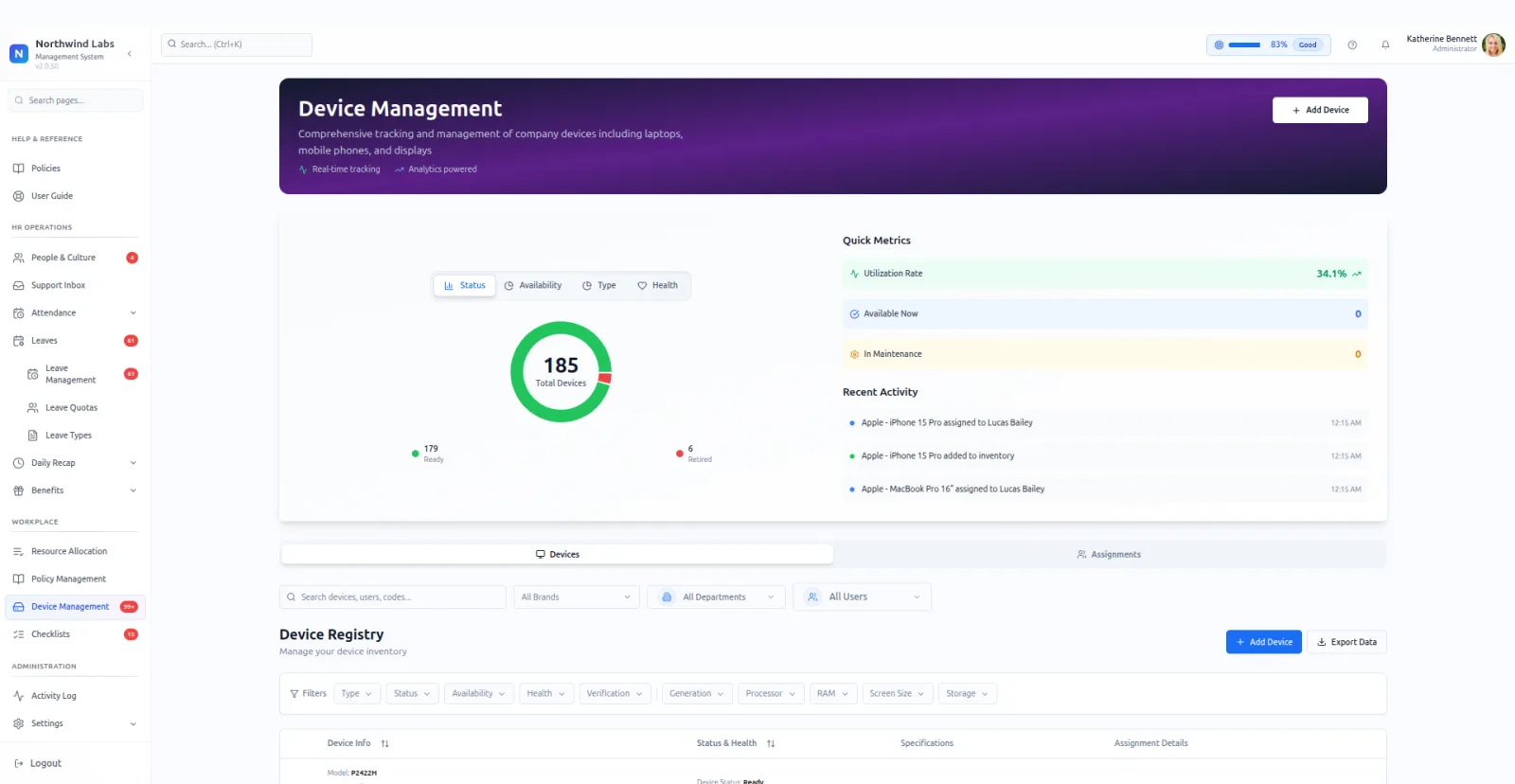
Status runs Ready, Under maintenance or Retired. Health is graded separately, so a working machine that is getting tired can be seen before it fails.
Verification is its own state, separate from status. Each device is marked verified once somebody has physically confirmed it against the record, and the rest are easy to filter.
Assignments are a second tab. A device shows who holds it and whether it is available, and the history survives the handover.
Filters go deeper than most registers: status, availability, type, health, verification, brand, department, user, and then generation, processor, RAM, screen size and storage.
Counts run across the top of the register: total devices, Ready, Under maintenance, Retired, a use rate and how many are available now. Export Data hands the whole list to anyone who needs it in a file.
Most offices hold more machines than people once you count the spare laptops, the test phones and the screens nobody claims. The deep filters earn their place at that size. Asking which laptops have 16GB and are free right now is a five-second job, and by hand it is an afternoon.
Splitting status from health is the other quiet good idea. A machine can be ready to hand out and still be the one that will die in March, and one field cannot say both.
Cost is the last check. Snipe-IT's hosted plans start at $39.99 a month on its own pricing page in September 2026. PeopleMuster is $3 per person, and the device register sits next to the people it's assigned to, in the same database.
What it does
- Serial, code and specs
- Model, brand, device code and serial, plus processor, RAM, storage, screen size and generation as filters.
- A verification state
- Recorded separately from status, so a row still waiting for a physical check is obvious.
- Assignment history
- Who holds a device now, and who held it before.
- Status against health
- Ready, Under maintenance and Retired answer availability. Health answers condition. Two questions, two fields.
What it needs before it works
- Somebody has to walk the office once with the serials. A register seeded from memory is the register nobody trusts.
- Device codes want a scheme before the first hundred rows. Changing it later means relabelling hardware.
- People need to be in the directory before a device can be assigned to them.
- Handover and recovery are usually worth an SOP template, since the steps repeat at every joining and leaving.
Questions people ask
What does the register record when a laptop goes missing?
The serial, the device code, the specs, the condition and every past holder. That is what a recovery call, an insurance claim or a police report needs.
What does the verification state mean?
That a person checked the physical device against the record. The verification filter lists every device still waiting for that check.
How much does the hardware inventory module cost?
Nothing extra. PeopleMuster is $3 per person a month, and the device register comes with every other module. Annual billing is $30 per person a year, and the first 14 days are free with no card.